
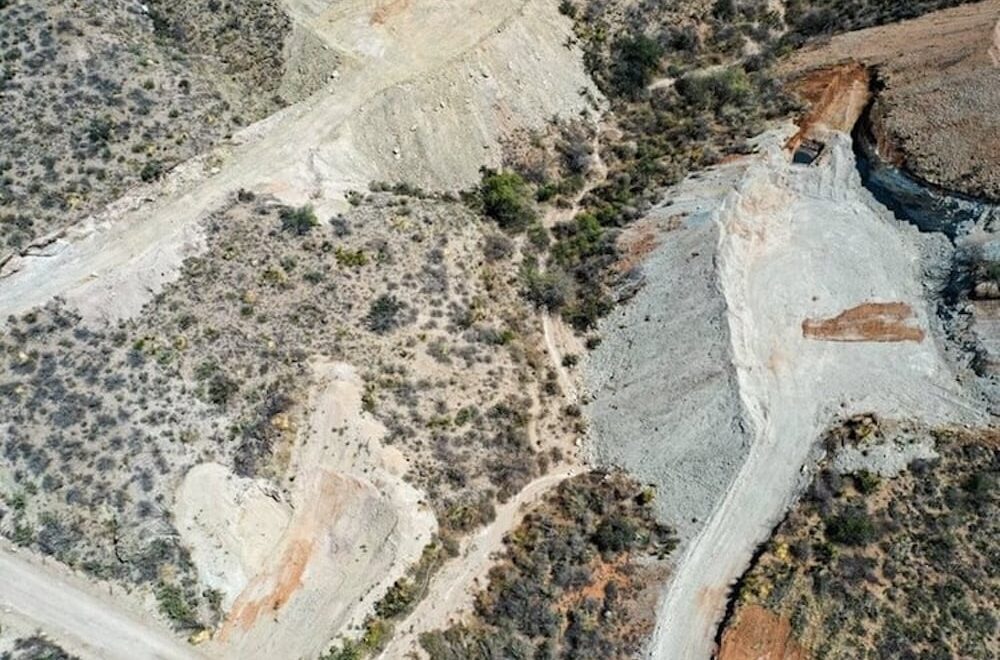
40,000 trucks, regional groundwater depletion and toxic tailings dumps
Massive groundwater pumping, 40,000 heavy mining trucks a year barreling across the Santa Rita Experimental Range (SRER) and through downtown Sahuarita, and toxic mine-tailings dumps abutting Corona de Tucson and the SRER are among the major impacts the proposed Copper World mine will have on the western side of the Santa Rita Mountains.
Copper World will greatly increase groundwater overdraft in Green Valley and Sahuarita
Toronto-based Hudbay Minerals’ proposed Copper World project will require enormous amount of groundwater. Hudbay intends to pump 9 million gallons of groundwater a day (3.285 billion gallons/year) from wells adjacent to the Santa Cruz River, according to a table in a 2022 Hudbay technical report. During the first 20 years of operation, the mine will require more than 70 billion gallons of groundwater.

The amount of water Hudbay will pump each year is more than four times the amount of water Community Water Company pumped in 2023. The CWC provides water to more than 13,000 customers in Sahuarita and Green Valley. The CWC relies entirely on groundwater.
The CWC reported pumping 741 million gallons in 2023, according to the company’s 2024 rate increase application with the Arizona Corporation Commission. Last July, the Commission granted the CWC a 24% rate increase for residential customers that went into effect on Aug. 1.
Hudbay makes impossible promise
Hudbay states on its website its “goal” is to “recharge and recycle” all the water Copper World will use to operate the mine. But the company’s plan has no realistic chance of success because it relies entirely on Central Arizona Project water to replenish the groundwater. The CAP transports Colorado River water across the desert through a 336-mile canal.
State records reveal there is nowhere near enough CAP water to replace Copper World’s groundwater pumping.
So far, Hudbay has only stored enough CAP water to recharge less than 1% of the groundwater it would extract from the Upper Santa Cruz River Basin beneath Green Valley and Sahuarita during the first 20 years of mining. The company has stated it plans to extend operations for at least another 24 plus years in a planned second phase of mining and increase the rate of groundwater pumping by 50%!
Green Valley and Sahuarita’s long term water supply is already threatened
The water supply in the Upper Santa Cruz River Basin, particularly beneath the Sahuarita/Green Valley area, already faces significant challenges due to historical and ongoing groundwater extraction.
The groundwater table has plummeted by 187 feet since 1965, causing ongoing land subsidence. The groundwater table decline is averaging 3.2 feet per year. The CWC reported that existing mining uses about 58% of the water pumped from the aquifer, agriculture uses 29%, followed by residential at about 8%, and other commercial operations at about 5%.
Groundwater replenishment is also being reduced because of upstream activities, the CWC told the commission. The groundwater flows from south to north, passing through the Nogales area, where treated wastewater is discharged into the northerly flowing Santa Cruz River, which replenishes the aquifer.
Nogales, Sonora has started using water that was going to a wastewater treatment plant in the U.S., thereby reducing a significant inflow to the aquifer. In addition, increasing development along the Santa Cruz River, especially in Rio Rico and Tubac, is resulting in more groundwater pumping, exacerbating the aquifer overdraft, the CWC states.
CWC’s plan to obtain Central Arizona Project water has been repeatedly delayed
The CWC has been working since 2007 to bring renewable surface supplies to the area to reduce groundwater pumping and slow the overdraft. The CWC has a contract to annually purchase 2,858-acre feet of CAP water. (An acre foot is equal to 325,851 gallons.) The CWC, however, has been unable to access this water.
The CWC and Hudbay have a joint venture called Project Renews to bring the CAP water to Sahuarita and Green Valley. The project, however, has been stalled for years. The plan requires construction of a nine-mile pipeline and recharge basins. Hudbay states in its 2024 annual report that the project is only 20% percent complete. After repeated delays, the CWC now states in its ACC filing the project is scheduled to be finished in 2028.
The ongoing severe drought, however, is causing substantial reductions in CAP deliveries of Colorado River water. The CWC’s allocation is not guaranteed and there is uncertainty of how much, if any, CAP water will be available if, and when, the pipeline is completed.
Groundwater pollution is also a problem
Freeport McMoRan’s Sierrita Mine west of Interstate 19 has polluted more than half of the area’s groundwater with a sulfate plume extending from mine tailings waste dumps. Freeport has implemented a groundwater pollution mitigation plan and continues to file regular reports with the Arizona Department of Environmental Quality.
Copper World threatens to make this situation worse from pollution seeping from three tailings dumps on the west flank of the Santa Rita Mountains into the groundwater.
Copper World would industrialize the Santa Rita Experimental Range
The 52,000-acre Santa Rita Experimental Range (SRER) is located between Sahuarita/Green Valley and the Copper World processing operations that will be constructed on the west flank of the Santa Rita Mountains. The SRER is owned by the Arizona State Land Department (ASLD) and managed by the University of Arizona. It is mandated by state statute to be operated for “ecological and rangeland research.”
The SRER is the oldest continuously utilized agricultural research station in the U.S. The SRER was established by the federal government in 1902 to conduct research to understand the semiarid lands ecosystem and apply sustainable livestock grazing management practices. Results of this research have direct applicability to over 20 million acres of semiarid rangelands in the United States and to another 20 million acres in northern Mexico. The Arizona State Land Department assumed ownership of the land in 1991.
Beginning in 2012, the National Ecological Observatory Network (NEON) established a 30-year research program measuring atmospheric and ecosystem gas exchanges, invertebrates, reptiles, birds, mammals, and soil properties. The SRER is considered a world-class facility – since its inception scientists have kept meticulous records of their research, resulting in a huge repository of information about arid grasslands and how to manage them.
Hudbay intends to construct an industrial corridor through the heart of the SRER to operate Copper World. The company has received right of ways from the ASLD to construct high voltage power and communication lines, a pipeline to transport water pumped from wells next to the Santa Cruz River to the mine site and a service road across more than seven miles of the SRER.
Copper World will require more than 40,000 heavy truck trips a year
Unlike most major copper mines in the Southwest that use rail to transport materials to and from the mine site, Copper World must rely exclusively on heavy trucks. Hudbay has not released a detailed transportation plan and it is not required to do so because the mine, which would become one of the largest open pit copper mines in North America, will be initially constructed on private land.
Copper World, however, includes the Rosemont pit on the east side of the Santa Rita Mountains. A previous Rosemont mining plan required preparation of comprehensive transportation plans because Rosemont would have impacted federal land on the Coronado National Forest.
These plans indicate that Copper World will require more than 40,000 heavy truck transits per year. That’s one heavy truck every 15 minutes, around the clock, for at least 20 years, and most likely 44 years if not longer. The trucks will travel across the unpaved Santa Rita Road through the SRER before using Sahuarita Road through downtown Sahuarita to reach Interstate 19.
The trucks will carry explosives and other dangerous materials in addition to transporting unrefined copper produced at the mine to overseas smelters. If a truck carrying explosives was to detonate, the impact zone could extend up to a one-mile radius.
The truck traffic will have a profound impact on daily life in Sahuarita and Green Valley. The truck traffic will increase the risk of accidents and fatalities, increase air pollution, damage roads, generate noise and convert the unpaved Santa Rita Road that bisects the SRER into a dangerous industrial highway.
So far, neither Hudbay, nor the Sahuarita Town Council, nor the Green Valley Community Council have alerted the public about the major impacts Copper World’s continuous truck traffic will have on the community.
Copper World will construct three massive toxic tailings waste dumps
Copper World plans to construct three toxic tailings waste dumps on private land abutting the SRER’s eastern border . The three dumps are noncontiguous and separated by U.S. Bureau of Land Management property and State Trust Land.
Tailings dumps typically contain trace levels of heavy metals that can seep into the groundwater or be dispersed by wind for many miles. Studies have found that toxic metals can show up in plants and soil as far as 30 miles from a copper mine.
Arizona has permissive environmental laws and regulations for mining operations. The Arizona Department of Environmental Quality (ADEQ) granted Copper World an Aquifer Protection Permit in 2024. The permit does not require a liner under the tailings dumps even though they are considered best practice of avoid groundwater contamination.
The ADEQ issued Copper World an Air Quality Permit in January 2025 that exempts dust blowing from the tailings piles from be included air quality measurements because they are classified as “fugitive” emissions that cannot be readily controlled. Toxic dust containing lead, arsenic and other heavy metals will likely blow onto houses and schools in Corona de Tucson. The Copper Ridge Elementary School is 1.4 miles from one of the planned tailings dumps.
The air permit regulations also exempt the dust generated from trucks traveling across the unpaved Santa Rita Road through the SRER. The dust can contain spores that cause Valley Fever.
The size of, and access to, the tailings dumps are crucial to Copper World’s operations. Hudbay has elected to avoid crossing BLM land to connect its processing operations with two of the tailings waste dumps to avoid federal environmental laws.
Instead, it has turned to the land department to obtain a crucial right-of-way to access the dumps and potentially purchase State Trust Land to expand their size.
ASLD violated state law when it issued Copper World tailings pipeline right of way
The land department, which reports to Arizona Governor Katie Hobbs, a Democrat, has taken illegal action to facilitate Copper World’s access to the tailings dumps and has rejected requests from Pima County, the Tohono O’odham Nation and SSSR to not sell state land to Copper World.
In December 2022, the state illegally granted a right-of-way for tailings pipelines across the SRER to Copper World. The right-of-way extends from Copper World’s processing plant to a tailings dump the company calls Tailings Storage Facility 1 (TSF-1).
A Maricopa County Superior Court ruled in September 2024 that the ASLD’s Board of Appeals violated the Open Meetings Law when it approved the right-of-way in a lawsuit brought by Save the Scenic Santa Ritas (SSSR) and Farmers Investment Company (FICO).
The state subsequently reapproved the right-of-way in a public meeting in October 2024. SSSR and FICO filed another lawsuit in November 2024 seeking to overturn issuance of the right-of-way because it would include multiple tailings pipelines.
SSSR and FICO allege the right-of-way violates state law that requires the SRER to be operated for “ecological and rangeland research.” The court ruled against SSSR/FICO in January. SSSR and FICO have filed an appeal.
State Land Department plans to auction 160 acres for a tailings dump on April 29
Hudbay has another private parcel northeast of TSF-1 that stretches north towards the unincorporated community of Corona de Tucson. This land, which Hudbay calls TSF-N, is separated from TSF-1 by 160 acres of State Trust Land.
Hudbay requested ASLD to put the 160 acres up for auction. The department’s Board of Appeals approved the appraisal of $993,000 for the 160 acres in September 2025.
After the board’s approval, SSSR (letter), Pima County (letter) and the Tohono O’odham Nation (letter) requested Arizona State Land Commissioner Robyn Sahid to not put the 160 acres up for auction.
Sahid rejected the requests during an Oct. 8 meeting with Pima County officials and indicated the department intends to auction the land next year, according to an Oct. 14 memo to the Pima County Board of Supervisors from County Administrator Jan Lesher.
“We will continue to advocate at the State Legislature and with the Governor to prevent this parcel moving to auction,” Lesher stated.
Depsite Pima County’s opposition, the ASLD announced on Feb. 6, 2026 it intends to auction the property on April 29, 2026. Hudbay is expected to be the only bidder.
SSSR is engaged in an extensive lobbying and advertising campaign to persuade Governor Hobbs to withdraw the land from auction.
ASLD is enriching Hudbay and facilitating groundwater depletion while ignoring Copper World’s potential negative impact on state land values
The land department’s decision to issue the tailings right-of-way across the SRER and plans to auction the 160 acres provide enormous financial benefits to Hudbay.
The more land the company has available to dump tailings, the more copper it can mine and the more profits it will generate. Hudbay could not operate the mine without the tailings pipeline right-of-way across the SRER unless it seeks a permit from the BLM, which would require extensive federal permitting review.
Hudbay has stated it could process an additional 41 million tons of copper ore worth more than $300 million if it obtains more land to dump tailings. The 160 acres the state plans to auction would allow Hudbay to process this additional ore. The state has appraised the 160 acres for only $993,000.
At the same time the ASLD is practically giving away State Trust Land for less than $1 million, the department has not conducted a financial analysis of the negative impacts the mine’s groundwater pumping will have on the value of State Trust Land located adjacent to Hudbay’s groundwater pumping wellfields.
The ASLD has conducted economic impact studies on the impact of selling State Trust Land to mining companies elsewhere in Arizona.
In 2019, the department conducted an extensive analysis of the expected sale of State Trust Land for a tailings dump at the proposed Resolution Copper mine east of Superior. The mine will require groundwater pumping that would reduce the value of other State Trust Land near Resolution’s groundwater wells by more than $530 million.
The ASLD formally objected to the Resolution Mine because of the negative impact the mine will have on State Trust Lands in an Aug. 4, 2025 letter filed in ongoing federal litigation.
The ASLD and Governor Hobbs, are ignoring the same situation that is unfolding with Copper World and the impact its groundwater pumping could have on the value of State Trust Lands.
The state Enabling Act and Arizona Constitution requires ASLD to manage all State Trust Land for the benefit of the trust’s beneficiaries, which is primarily public education.

The Arizona State Land Department’s 2017 right of way for a high voltage power line and water pipeline issued for the Copper World Mine Complex crosses seven miles of the Santa Rita Experimental Range (tan) and is adjacent to the unpaved Santa Rita Road, which will become the main access to the mine site.
The department’s 2023 mine tailings right of way (black) connects Hudbay’s mine processing operations with a mine tailings waste dump planned for the “F” shaped parcel in red (TSF-1). Mine tailings will also be dumped on the red strip of land immediately northeast of the “F” parcel (TSF-N). Hudbay wants to purchase 160 acres of ASLD land (blue) that would connect the two tailings dumps. The ASLD has scheduled the auction for April 29, 2026.
Leave a Reply